
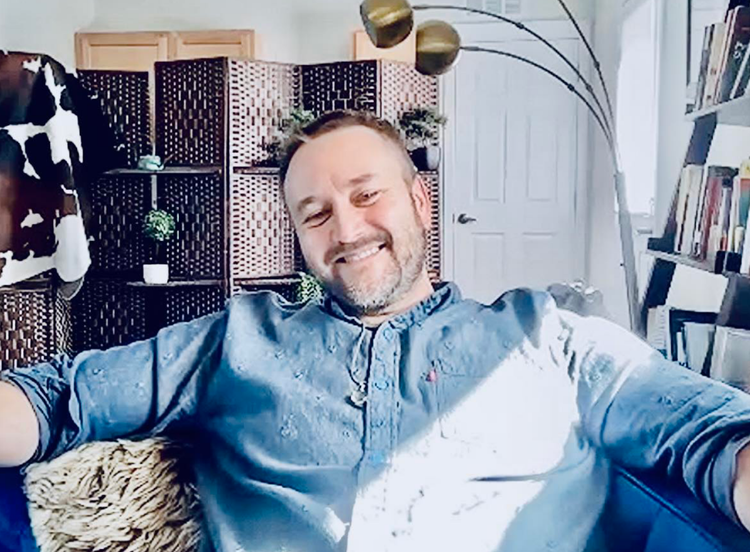
Deborah Pollack - I am just a temporary, surrogate other to help you get back to the real people who matter in your life.

If we start with the case you’ll be presenting, you’ve provided some background but is there something you'd like to say more about?
I think it's a good example of a few things that I wanted to talk about. It's so hard with these cases to narrow it down and edit, because you just don't have that much time. But it's cool to go back and find all these different aspects of it through the editing process.
One of the things I've been wrestling with is, do I show parts that are, like, illustrative of good classic sort of ISTDP moves? Or do I show something that's maybe a little bit different that is something that I like to talk about and I like to teach?
So, I think I'm going to head in the direction of the latter because everybody's seen the classic ISTDP stuff. And it's not like I do it any better than anybody else, you know?
We’ll be happy to see that, I think we’ve all seen the classic moves.
I don't want to give too much away but I want to show the parts where he's disappointed in me. That's connected to – I don't know how many people will be aware of it – my time-limited model of ISTDP that I wrote about in the journal a few issues ago. He's a time-limited case.
I don't want to give too much away but I want to show the parts where he's disappointed in me.
With these cases, they get the trial session and then they get 12 subsequent sessions. So, towards the end of our time together he's sort of facing the inevitable disappointment that all of my cases face. I would argue that any case would face the fact that I've disappointed them even if I didn't have a time limit. I helped them, but I wasn't the person to save them. They often have a fantasy of the therapist being able to do things that we just can't do.
I've always thought it's really, really important to help people face that inevitable disappointment, and the way that I do that is through the classic ISTDP techniques. Like, what are you feeling towards me for disappointing you? To get the anger out towards me and also the grief in recognizing that I am a human, and I'm not going to save them. And I'm not going to be with them forever and be their new parent or something like that. That's super disappointing and can we face that reality together?
I've always thought it's really, really important to help people face that inevitable disappointment
I guess we would call it an omnipotent transference fantasy and it comes up pretty quickly in my work with them, so that they can then face their own reality and the limitations in their own reality. And grieve the loss of that fantasy and then face the question of what they want to do with what they do have, and the limitations of their life.
This case in particular, he's been unhappily married for a long time and comes in not knowing whether he should leave his wife or not. But the twist is that the wife now has a life-threatening illness.
That’s bringing up all these feelings for him, the unhappiness that they both had in the marriage, which through the therapy we realize is the result of both of their defense mechanisms playing out over the years.
As we help him face that and all the time lost, of course a lot of grief and rage comes up. Then he really has to face some ethical and existential questions. Do I leave this person in her hour of need? Even though she hasn't been very nice to me, I've also committed to her and I love her. So it’s helping him face and work through those feelings.
That's a tough one. What were some of the fantasies that he might have had about how you would have been able to save him?
Yeah, I don't know how much it was consciously fully articulated in his mind. I think if he was to put it to words, it's a fantasy that most of my patients have, that I would have all the answers, that I would tell him what to do.
Actually he did verbalize it to some extent, even at the beginning of the therapy. He was hoping that I would tell him what to do, and then he would do that thing, and then he would go on to have this incredible life that he had missed out on. Probably free from guilt, in some way, in his mind, if I gave him the right answer.
Because who doesn't want somebody to give them the answer that's gonna fix all those problems and free them from facing their own ethical dilemmas.
When I don't give him that answer and he has to realize that's a choice he has to make and he has to face all the feelings about that, and he has to face his own ethical dilemma regarding the decision, and that's really disappointing. And I get it. Because who doesn't want somebody to give them the answer that's gonna fix all those problems and free them from facing their own ethical dilemmas.
I guess that’s something that therapy as a field in general does advertise a bit, the “liberatory potential” of psychodynamic therapy and psychoanalysis. Maybe that could feed into such ideas?
Right. I think that it's a bit of a dangerous discourse to talk about the liberatory potential. I mean, there are ways in which psychoanalysis and psychotherapy can be freeing us from a lot of our habitual defense mechanisms. Things that we do that keep us limited from a lot of important aspects of life, like love and work and getting satisfaction and those things.
But when it comes to all of us human beings, we also consciously or unconsciously want to get an ultimate freedom from suffering. We all have that desire even if our rational mind knows we can't ever really truly escape suffering as long as we're alive. Yet we still all hold that desire inside us. Because life is really painful and it's full of suffering.
And so when psychotherapists talk about and market this idea that this method can provide some freedom and liberation, it taps into that desire that we all have to finally get out of the inevitable suffering of life. I think we have to be conscious and careful of that and just recognize that our discourse when talking about liberation and freedom is going to fuel some of these fantasies that people bring with them into psychotherapy.
They can view us potentially as the person that's going to free them, their savior. And we can often unconsciously support that, and buy into that ourselves. A lot of us come into this field because we want to save somebody from our own childhood, and so these savior fantasies tap into this desire that many of us have as well.
Would that be more of an omnipotent or a transcendent fantasy, or how would you conceptualize that?
I think it's all related. I've been rereading Norman O. Brown's book Life Against Death, The Psychoanalytical Meaning of History. Because in the talk, I wanted to talk about existentialism and its overlap with society and psychoanalysis. There are so many amazing authors I could talk about, but I thought let me just limit it to one who's really good.
So he talks about how universally as human beings we all have a desire to overcome death, overcome suffering, and this is something that Freud stumbled upon. In the psychoanalytic project the way to do that is to go back to childhood and free yourself through some of the limitations, or for lack of a better term, the traumas that childhood created.
But that is ultimately an unsolvable problem. You can't really free yourself from all of that. So it's a universal desire that has to do with transcending the dilemma that we all have in life. That we have these limitations and life is full of pain and suffering and yet we can’t ever fully get over that.
Brown talks about how Freud recognized this truth, especially towards the end of his career, like in Analysis, terminable and interminable. So ultimately Freud was somewhat pessimistic about the psychoanalytic project in a way that his students and the subsequent psychoanalysts weren't.
That connects to Davanloo, who talked about how Freud gave up, he got pessimistic, he got depressed. But I think, and Norman O. Brown would agree, that Freud was just seeing reality. One of the really interesting things I was reading in that book was about how the Oedipal project is not just about the family triangle and wanting to have your mother for yourself.
I mean, it kind of is about that, but it's also about how overcoming the father is really this idea that you can ultimately overcome death. That you can transcend, that you can “be your own person,” and we can't ever really do that.
It's also about how overcoming the father is really this idea that you can ultimately overcome death
So that is what brings it back to this omnipotent striving that unconsciously probably a lot of therapists have. Because all people have that, and it can play out in psychotherapy in ways that I think can be problematic when the therapist takes on the mantle of being the savior and the patient follows suit.
That's an Oedipal striving. I'm going to overcome, I'm going to conquer. Also related to our underlying ultimate angst about the fact that we're going to die. To be the superman that can overcome all of this.
That's some of the stuff that Maury and I have been talking about as we reread Davanloo's case The German architect, that we see hints of that in Davanloo and how he talks about Freud and how he talks about cases.
You also venture that he might have had that sense oedipally with Freud as a father figure.
Yes.
So how do we account for the fact that it was so productive for him?
Yes. That's the question, right?
People can have a little omnipotence as a treat?
Sometimes. I think it's not just unique to Davanloo, though, right? I mean, we're all really immersed in ISTDP and we see how helpful it can be. There's lots of stuff that's incredibly helpful about ISTDP. I mean, I wouldn't have spent almost two decades now studying it and devoting a lot of my time to it if it wasn't.
There's lots of stuff that's incredibly helpful about ISTDP. I mean, I wouldn't have spent almost two decades now studying it and devoting a lot of my time to it if it wasn't.
But I also like to zoom out and look at the whole history of the field of psychotherapy. There's a lot of other figures like Davanloo across the field of psychotherapy who are equally as charismatic and powerful in their approach and really helpful to a lot of people.
I'm thinking of people like Marsha Linehan who developed DBT, she completely transformed and saved many, many people's lives and she was also like a very charismatic figure. Even somebody like Albert Ellis who I completely disagree with the way he does therapy in so many ways, but he had his shtick, as we say, and he helped a lot of people.
I think there's something about all of them that they have in common, a healthy dose of… I don't know if I want to say healthy, but they had a lot of narcissism. They had a particular personality, a very strong personality. They really believed in what they were doing and somehow parlayed, I think, certain parts of their personality into the therapeutic method in a way that really worked for a lot of people.
These are very different types of therapies. Davanloo is Neo-Freudian, Eliis is one of the forefathers of CBT, Marsha Linehan is a new behaviorist, but they all were really helpful to a lot of people in the world. So I don't think it's something necessarily unique to Davanloo and I think it's really helpful to kind of zoom out and see that.
One of the things that Maury and I are going to talk about next, we're finishing up The German Architect now, and the guy had some pretty significant breakthroughs and reached a new level of insight, so one of the conversations we're going to have next on the podcast is given some of the problems that we see in the case in terms of Davanloo continuing to be in the shoes of the transference. Taking on the authoritarian role and never really getting out of it, in our opinion. How can we explain what happened here that seemed to be an authentic movement for the guy?
By the way if someone is reading this and haven't listened to the podcast they probably should since they’re likely the audience for it. In the last episode it was nice how after your close critical reading, the case in the end was just so convincing, too convincing kind of. I wanted to ask also what has changed in your own reading of Davanloo so far?
I guess it's changing all the time but yeah, going back and doing a close read was really helpful. I think I'd read that case several times in the past but I think I was just skimming over certain things. So going really slow and considering things like, look at this odd turn of phrase that Davanloo is using. Or noticing there were a couple slips that I think Davanloo made that reveal his own, maybe unconscious, intentions or agenda.
It was really interesting to see some of that and to recognize some of the ways in which the patient slips and what I think, unconsciously, he was trying to get out of Davanloo so that he could heal. I think maybe one of the reasons it did work was, to use ISTDP terminology, the power of the Unconscious Therapeutic Alliance. The guy kind of knew where he needed to go and he got them there just as much as, maybe even more so than Davanloo got them there.
It was really interesting to see some of that and to recognize some of the ways in which the patient slips and what I think, unconsciously, he was trying to get out of Davanloo so that he could heal.
I think my biggest takeaway so far from that case is that Davanloo, like all of us, has a particular perspective on what potentially heals in psychotherapy and how to understand the origins of an individual's suffering. He has a particular framework for that, a very Freudian, oedipal framework. Which, again, is fine. We all, at different points in the history of psychotherapy, have to take on a particular framework for how we understand and conceptualize a case.
But it was helpful to see how Davanloo, in my opinion, in some ways, kind of tried to make the guy fit his perspective, fit his framework. And, again, I think we all kind of do that, so it's not unique to Davanloo. I'm not trying to pick on him. It's just kind of seeing that he's a human psychotherapist, like all of us he has a particular perspective on what causes suffering and what heals.
It's not the universal truth with a capital T. It's the notion that we're all perspectival and that doesn't mean it doesn't work. But I think it's important to recognize that there's many, many roads that you can take. This is one road and it's okay for us to take a critical eye to that too, which is something that I think what Maury and I are trying to do is make it okay to be critical of Davanloo and to really have your own mind in examining it and questioning what he was doing here.
It feels like that exists now, besides qualitative and qualitative research there’s also a Davanloo studies type of thing. You and others have opened up for critical readings without branching off into a new model of therapy.
I was thinking about Robert Johansson and Peter Lilllengren's recent study that they just posted to the EDT listserv where they reanalyzed the data from an Iranian study where the outcome showed that ISTDP was an effective for treatment-resistant depression. But they went into the data and looked at specifically whether the hypothesized processes in the therapy itself were what led to the changes? They found that it wasn't necessarily the case, that the hypothesized mechanisms didn't stand up to their quantitative analysis.
It's like what we're talking about with Davanloo, it worked, but maybe not necessarily in the ways that we think it worked. I think that was a really cool finding and really supports what we're talking about going back and looking through Davanloo’s cases. It worked, but should we also consider alternate hypotheses for what actually is happening here?
You also referenced there your qualitative study where the participants did not describe very much in terms of transference experiences with the therapist as the most pertinent aspect of their experience.
That was kind of eye-opening, that through the data, that's just not really what they focused on. In ISTDP we're taught to focus so much on the transference, that the transference is sort of the gateway to reorganize the person's object relations and their interpersonal defense mechanisms.
The patients that I interviewed, it's not generalizable because it's only five people that I interviewed, but they really didn't talk about transference work much at all as part of what were the most healing elements of the therapy for them.
So what does this mean in relation to the concept of the person of the therapist, the theme of the upcoming IEDTA conference? I really take the point about the person of the therapist and the real relationship, if we can make space for ourselves as persons while we're working, that's great for us, we can probably do a better job. But is it more important to us than it is to the patients?
Yeah, I think so sometimes. I mean, this is what I talked about in Malmö. I think that we, as therapists, might have a tendency to overinflate our importance and that can be dangerous and problematic. I've been seduced by that, for lack of a better term, throughout my career as a psychotherapist and I've seen where that has really blown up in my face and created what we would call a transference neurosis.
I think that we, as therapists, might have a tendency to overinflate our importance and that can be dangerous and problematic.
That's been really problematic, I've gotten stuck in that with patients and I think it actually caused a lot of my patients more harm than good. So over the years I have really been trying to walk back my importance to the patient as a figure in their life.The time-limited model is one way that I do that. I don't think it's the way, I think it's a compromise I've come up with in the lack of having other ways to do it.
But I think one of the things that I'm going to talk about for the ISDTP Academy with this case is how much I really prioritize being a regular person and helping the patient face their disappointment in me, almost as quickly as possible, to kind of counteract that potential inflation of our importance in the person's life.
Because you know, I don't ever want to be the most important person in their life. I want to be a little helper on their journey that can shift them a bit to get onto a better place that they want to get to. But if I become the most important person in their life, that is really problematic in my opinion and I think it's really dangerous. I want them to turn back to their own life and their family and the people that are the most important to them and figure out what they need to do.
I think something we all get seduced by is the idea that if we work on ourselves, we can do more for people. The transference neurosis that you mentioned at times in your career became more of a thing until you found ways to move out of that and the limited format was one of those things, what else has been helpful for dealing with that?
Um, just when I noticed within myself, any hint of unconscious fantasy of like, wanting to be the savior, wanting to be the new attachment figure for this person or something like that. I try to walk myself out of that and realize I'm just, I don't know if you guys use any Yiddish in Sweden, but I'm just like a regular schmo like everybody else. That's one of the phrases that my own therapist used with me.
I know schmuck but schmo is something else?
A schmo is not as bad as a schmuck. A schmuck is like a bad person, a schmo is just an everyday Joe, like an everyday guy. No better or worse than anybody else.
So this idea that you brought up, that in order to better help our patients, we need to continually work on sort of clearing out our own problematic defense mechanisms. Okay, but you could just do that for eternity also. That's not going to get you as a therapist out of being a regular schmo either.
There's a joke term in the terminally online world that kind of stuck with me, normal person-maxxing.
So you guys have the whole maxxing trend in Sweden too?
We're like a 53rd state or something, our media environment is just an extension of the U.S. basically. So yeah to some degree for sure. To loop back to narcissism and also your book project, are we facing increased demands of how we should be as therapists? Therapymaxxing?
Mm-hmm.
If we compare now to let's say 70s, 80s, around the time of the German architect, was it more acceptable as a therapist to be a bit gruff, domineering?
Yeah, I think in some ways and that probably goes back to the changing family structures over the generations. Families were different back then and parents were different, I don't know about in Europe, but in the United States the father could be more distant, more gruff, more authoritarian, parents were more authoritarian in general.
It was prior to these movements that we've had more, you know, in the last, like, 40 years with more gentle parenting, attachment parenting, which are good movements I think. I'm not necessarily criticizing those.
But so when people would come into therapy in the 70s and 80s, having been parented by that generation of parents, who are much more authoritarian and distant, with their own parental transference going on to the therapist, they would probably expect the therapist to be more authoritarian with them, just like many parents were at the time.
So I think with the changing ways in which we parent these days, that has shifted into different expectations for how your therapist will sometimes relate to them. With the continual inflation of our collective cultural narcissism problem and the commodification of therapy culture, people now come to expect that, you hire a therapist kind of like an accessory that you have available to you at all times, like a balm.
I think therapists now have become more like products that people can buy to support their narcissism.
And because of the techno-commodification culture, where your therapist can be on this thing that you carry with you all the time (holds up phone), I think therapists now have become more like products that people can buy to support their narcissism.
Rather than, I do think like back in the seventies and eighties, therapy was seen as something a bit different, again because of all of those cultural changes and cultural shifts. Yet I think the seeds for that were planted back then, which is what my book is basically about. Tracing the development of that, probably going all the way back to the beginning of the 20th century.
Luckily there were a lot of incredible authors who did a lot of that work, tracing the development of psychotherapy through the 20th century. But then I haven't found anything that took that into the 21st century. What I'm trying to do is take some of what authors like Phil Cushman and Christopher Lash and Philip Rieff talked about, how the field of psychotherapy has been reflective of and supported our cultural narcissism and the inflation of that.
Then I'm going to take that into the 21st century with all of its newer developments, especially the technological developments, and how those have really shaped the field of psychotherapy to put all of those issues on hyperdrive.
I was thinking now that this means that over time there's been a drift in what equidistance or neutrality would mean in relation to the patient's transference, so that maybe we must then necessarily be a little more narcissistic or perfectionistic towards ourselves as therapists to be able to work with the patient. Could that be amplifying those processes?
Well, I think we can't ignore the role of capitalism in supporting that. The world of psychotherapy from when I first became a psychologist, which was 20, 25 years ago, is now dramatically different, at least in the United States. You have to market yourself in a way that is completely different, you have to have a niche, you have to worry about search engine optimization, digital marketing.
You guys have a different healthcare system so it's a bit different, but in the United States, it's just kind of like, especially since COVID where everything's gone a lot over to telehealth, there are these massive telehealth practices. It's like a pyramid scheme, basically, where there's a person at the top who owns the practice, who's really just trying to make a lot of money. I'm not blaming them, because the field of psychotherapy, unfortunately you can't necessarily make a lot of money if you're just a therapist, so the system sets us up to have to find creative ways to make more of a living, and owning a group tele-therapy practice is now a very common way of doing that.
But then what they have to do is have a pyramid structure where they're just hiring all of these therapists to see as many patients as possible. It's a commodification of psychotherapy that I think is really problematic for the patients and can exploit the labor of the therapists. It's just gotten worse and worse since COVID and the rise of the gig economy, and that's impacted psychotherapy with it being delivered via app and telehealth.
They can extract more value from therapists in these telehealth factories here in Sweden too. But the market hasn't really consolidated yet so there's like five to ten companies that are big actors. What I'm thinking as a union rep is that over time, when it consolidates to one or a few major actors then at least people hopefully might be able to unionize and negotiate the terms more. But it's not going to change the mode of production of therapy, for sure.
I think we all have to face that thing. You can shop around for therapists in state funded healthcare, too, endlessly sometimes. Those of us working there can easily function as commodities. There can always arise this demand that you turn the gaze on yourself and start thinking how do I need to seem, how do I need to be, how do I need to change in order to help this person or get that job.
Yeah, it's an inhuman amount of pressure that we face that I don't think necessarily we recognize. I think it's in the water, so to speak. I think it's really unfortunate for all of us.
The subtitle of your forthcoming book is Escaping the Hall of Mirrors, I googled that to see if it was in reference to something and got this Google AI response that told me how to get out of an actual hall of mirrors.
Like from a carnival funhouse type thing?
Yeah. And the thing apparently is you touch glass, it told me I need to do that.
That's interesting, it reminds me of, like how in the States the Gen Z kids say, “touch grass.” Which is when they want to get off the phone. So it's kind of like getting out of all of this (holds up phone) and, you know, facing reality again. Getting out of yourself.
Another online term I thought of that I've seen is “exiting the clout matrix”, meaning to stop caring a bit about profile building and what not and just do what you care about and hope that that's going to work. I guess you're still writing but could you say something about escaping the hall of mirrors?
It's basically returning to bringing ethics back to a focus in psychotherapy, which is something that I think ISTDP allows us to do with the focus on helping people get back in touch with guilt over real or imagined ways that they've hurt people that they love.
I think when we bring an ethical focus back to psychotherapy, not in a virtue signaling kind of way, or a social justice kind of way where the therapist is trying to convince the patient to follow their own particular ethical guidelines.
To help us get out of psychotherapy as this endless project of self-reflection and self-improvement and shifting our focus more externally, like how do I help the Other?
But helping the patient get back in touch with themselves as an ethical being in a way where they can turn away from their own narcissism as much as they can. I don't know if we can ever fully escape that and always be turning away from ourselves and towards the other, whoever the other is. To help us get out of psychotherapy as this endless project of self-reflection and self-improvement and shifting our focus more externally, like how do I help the Other? How do I get out of myself? All of the things that we've been talking about.
Look, this thing [holds up phone], whatever we're doing here is its own version of the hall of mirrors, and getting out of that and turning outwards to, in Judaism, we say like tikkun olam, repair the world. And that’s really getting out of ourselves, it's continually trying to get out of the endless inward gaze of our own narcissism, if we have any hope to do so.
I'd love to hear more, but I got to run to pick up at preschool. Maybe I'm escaping the hall of mirrors right now?
Haha, yes, you are!
Oh I forgot my shtick question that I ask everyone in these interviews, the one about flavor, what edible or drinkable thing would you choose to convey the flavor of what you're like as a therapist?
Hmm… the first thing that comes to mind is a diet coke. It’s like, good but not the real thing. Which is kind of what I’ve been talking about. I am just a temporary, surrogate other to help you get back to the real people who matter in your life. And sometimes people get a bit addicted to diet coke but they ultimately feel so much better when they give it up.



Diskussion